

The Story Behind the Feast of the Three Hierarchs
- John Coffman

- Jan 30
- 6 min read
Updated: Feb 2
From the Great Synaxaristes
On the 30th of January, the holy Church commemorates
our œcumenical teachers and holy Fathers
BASIL the Great, GREGORY the Theologian,
and JOHN Chrysostom.
ORIGIN
The three holy hierarchs, Saints Basil the Great, Gregory the Theologian, and John of the Golden-mouth are commemorated today by reason of the following event. In 1081, Emperor Alexios I Komnenos of Constantinople (1057-1118) came to the throne with the support of the military aristocracy, after Nikephoros III Botaneiates. At that time there came to pass in Constantinople a contention among men of high repute and virtue. This vigorous controversy came about in regard to the three great teachers and hierarchs, and which of them should be the greatest. Some preferred the great Basil on account of his treatises, which vividly and articulately examined the nature of things in existence. This group also lauded Saint Basil's virtues, not only likening him to the angels, but even believing that he rivaled them. They also approved of his practise of not absolving sinners in an easy or offhand manner. They applauded his serious disposition, and his freedom from being possessed of anything earthly. Now this same group also would have placed the divine Chrysostom in a lower place than Basil, since they believed that he readily absolved sinners.

Yet another faction elevated the holy Chrysostom over both Basil and Gregory, maintaining that his teachings, filled with wise and agile expressions, guided all and drew sinners to repentance. This group mostly favored Saint John on account of the multitude of his mellifluous writings, and the loftiness and breadth of his thoughts.
Others, however, favored the writings of Saint Gregory the Theologian and gave him the preeminent position. They enjoyed his elegant and diversified manner of writing. His elevated and flowery style surpassed that of both the philosophers of Greek wisdom and Church writers to that date.
Thus the Christians were split into three rival groups, which named themselves Johannites, or Basilians, or Gregorians. Consequently, since the Christians could not settle the issue, a visitation, not a vision, was vouchsafed to Metropolitan John Mavropous (ca. 1050-1075) of Efchaita, a holy hierarch who attained to the summit of virtue. He was a notable and erudite man, well acquainted with Hellenic wisdom, of which his writings bear witness to his learning. He was also acclaimed for his writing of hymnographic canons and the lives of the saints.

Metropolitan John affirmed that the three holy hierarchs appeared to him first individually and then together. He says that they spoke to him as with one mouth, saying, “We are as one before God. Even as thou dost see, we neither have any opposition to one another nor have any quarrel among ourselves; but in accordance with the times in which we happened to live, each of us, moved by the divine Spirit, taught and wrote about various themes. Now as much as we learned by the Holy Spirit, these same teachings were also published for the salvation of the people. There exists among us no first or second place; for if the one should speak, straightway the other two also are in agreement. For this reason, command the rivaling factions not to remain divided on account of us; for even after our translation, as when we were among the living, we are concerned and eager to bring peace, unity and oneness of mind among the faithful, and not to be the cause of division. Therefore, when it seems fitting to thee, unite our commemorations on one day, and compose a troparion for the feast; for we are as one before God. And be certain that we shall cooperate toward the salvation of those who celebrate our general commemoration, since we have boldness before God.”
After the saints uttered these things, they appeared to ascend again into the heavens, illumined with brilliant light and calling one another by name. Therefore, John of Efchaita was stirred in his heart and set about doing as the divine hierarchs gave him charge. Indeed, he calmed the multitude of people and brought peace among the contending factions, because he was known by all as a virtuous man. Therefore, his words were mighty and persuasive. He delivered to the Church of God the common celebration of these saints. And behold, thou reader, the understanding and discernment of this divine man. When he found that the month of January already dedicated three days toward the commemoration of these very saints (the great Basil on the 1st, the theologian Gregory on the 25th, and the divine Chrysostom on the 27th), he united their celebration on the 30th of January. The namesake of grace, Metropolitan John, was enlightened and directed by the holy hierarchs when he composed a service, adorning it with superior canons and troparia, and an encomium, which was meet for such great fathers of the Church.
THEIR PHYSICAL APPEARANCES

The three hierarchs, according to their physical appearance and facial characteristics, are described as follows. The divine Chrysostom was short in stature, lean, and slightly built. He was both pale and fair-skinned. He had a large head, long nose, and broad nostrils. His eyes, large and deep set, shone forth with beauty and grace, though his other bodily members seemed afflicted. He had a towering forehead, etched with many wrinkles, and with no hair on top. He wore a small but comely beard, which was putting forth a few white hairs. His cheeks were sunken from fasting. He was acclaimed for his accurate, florid, and eloquent words and expressions, and the breadth of his understanding, teachings, and wisdom, which surpassed those of all the wise men and rhetoricians of the Greeks. He not only became great in both practical and theoretical philosophy, but also surpassed all others by his virtues. He was a fount springing forth love, charity, and philanthropy. He reposed at the age of sixty-three.
Saint Basil the Great was a tall and slender man, but he looked emaciated. His complexion was swarthy and yellowish (on account of his liver ailment). His nose was long, and his eyebrows were rounded. A few wrinkles marked his face, and his cheeks were large. He had bushy hair at his temples which twisted up, encircling his head. Yet it gave the appearance of being slightly cropped. His beard, sufficiently long, was black, sprinkled with grey. Now he succeeded in attaining to every kind of learning. In anything that was taught in art or science, this saint surpassed all his distinguished contemporaries and those from times past. Saint Basil not only pursued secular studies, but also struggled and practised that true philosophy; and through activity he ascended to contemplation. He reposed at the age of forty-nine.
Saint Gregory the Theologian was of average height and build. Though somewhat pale, his countenance appeared grace-filled and his features elegant. His eyebrows were even and his nose broad. His right eye appeared somewhat inflamed when compared to his left, for in his boyhood he suffered an injury to the surface of that eye. His thick beard was substantial, but not very long. He was almost bald, except for the tuft of white hair that went round to meet his full turning beard. His easy-to-approach manner was mild and mellow. It is worthy of remark that if it were possible for one to become a living and breathing pillar made up of the virtues, this pillar certainly would be the great Gregory. This is because he was more than conqueror in both the active and contemplative life, and completely prevailed over all others with his wisdom, words, and dogmatic teachings. Thereupon, he deservedly received the title of theologian. He reposed at the age of sixty-two.
CONCLUSION
Since these three hierarchs labored for our salvation, we ought to commemorate their feast and please them as much as possible. These thrice-blessed saints have no other concern or thought, other than to make steadfast Orthodox piety with the pure confession of the Faith in God the unoriginate Father, God the only-begotten Son, and God the Holy Spirit Who proceeds from the Father.
Through the intercessions of this sacred triad of hierarchs, may the Church be granted peace, and may we be vouchsafed to glorify together the Father, Son and Holy Spirit, the one God, to Whom is due all glory, honor, and veneration, now and ever and unto the ages of ages. Amen.
SOURCE:
The Great Synaxaristes of the Orthodox Church: January Volume (Buena Vista, CO: Holy Apostles Convent, 2010), pp. 1158-1162. Reprinted with permission, courtesy of Holy Apostles Convent & Dormition Skete.
DON'T FORGET!
New from Uncut Mountain Press!
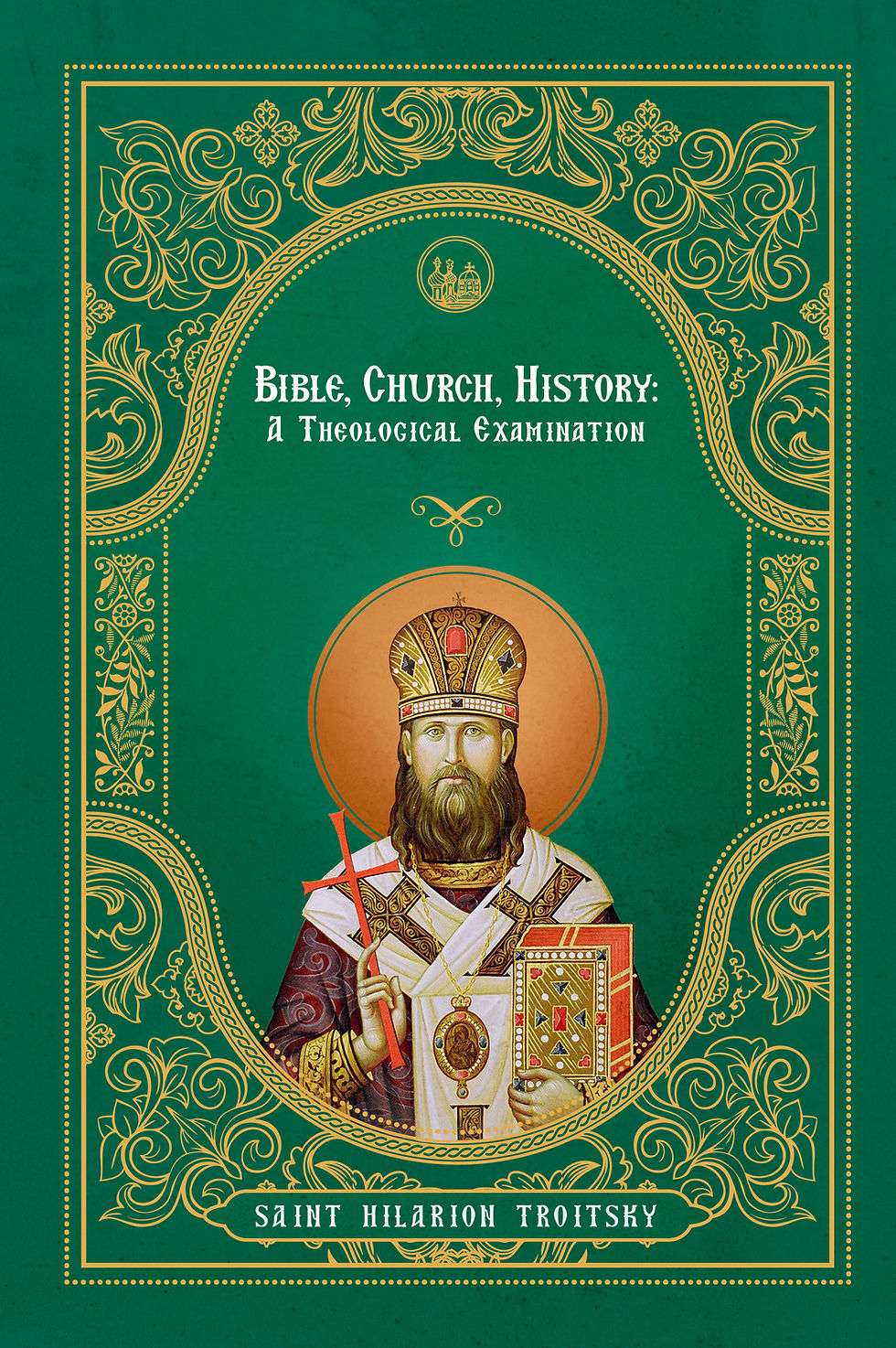
Purchase Bible, Church, History and get Volume I of the series, On the Dogma of the Church, at 25% OFF! For a limited time only. Offer expires on February 1, 2026.


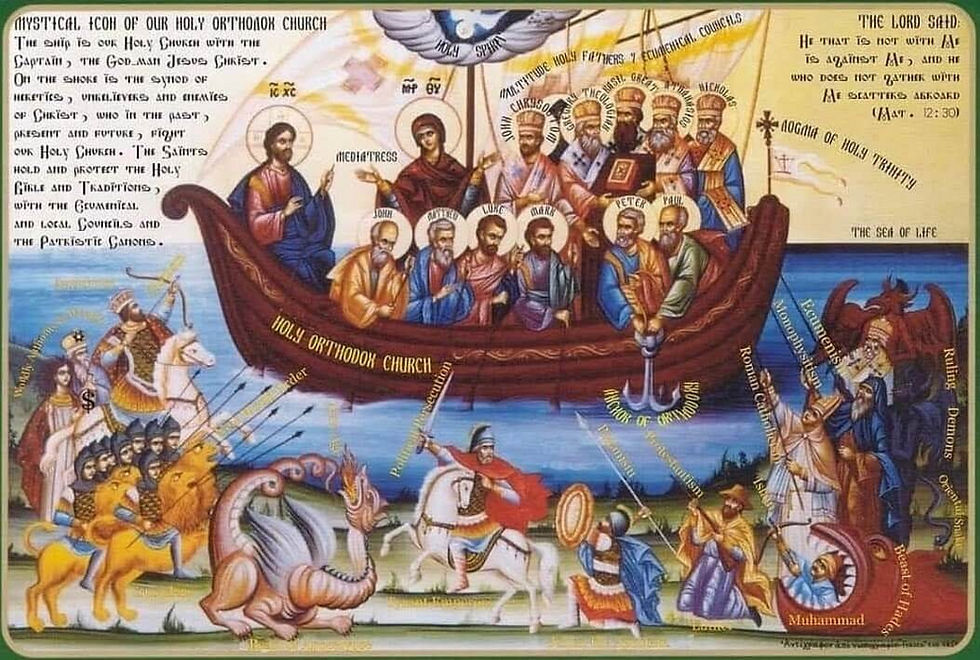
“Human beings have accumulated in their coffers gold and silver, clothes more sumptuous than useful, diamonds and other objects that are evidence of war and tyranny; then a foolish arrogance hardens their hearts; for their brothers in distress, no pity. What utter blindness! . . . Attend not to the law of the strong but to the law of the Creator. Help nature to the best of your ability, honor the freedom of creation, protect your species from dishonor, come to its aids in sickness, rescue it from poverty …. Seek to distinguish yourself from others only in your generosity. Be like gods to the poor, imitating God’s mercy. Humanity has nothing so much in common with God as the…
thank you for this knowledge. i wish i had more knowledge of the saints