

The Orthodox Cosmological and Vocational Map of Everything - Analyzing St. Maximus' Ambiguum #41
- John Coffman

- Jan 20
- 16 min read
Updated: Feb 25

Editor’s Note: Yesterday was the Feast of Theophany on the Church Calendar (Old Style) and tomorrow is the Feast of St. Maximus the Confessor on the New Style Calendar. Therefore, today’s offering is an extremely valuable commentary on God’s Creation which St. Maximus analyzes in the context of St. Gregory the Theologian’s homily on Theophany, found in Ambiguum 41.
In this letter, a man named John asks St. Maximus to explain what St. Gregory means when he teaches “The natures are innovated, and God becomes man.” In response, St. Maximus lays out the entire structure, one could say, of absolutely everything and also how man’s role is to unite all things to Himself; but Christ is the only one Who properly did fulfill this vocation. St. Maximus gives us a critical interpretive tool for understanding God’s creative acts from the beginning of Genesis through the end of Revelation. Better known is St. Maximus' “Mystagogy” (especially in Chapter 7), where he presents the basic idea of man a microcosm of all Creation and Creation a macrocosm of men’s souls. In Ambigiuum 41, you will notice an expanded analysis of this phenomenon. Since many are beginning to pick up this teaching on St. Maximus, this post offers the saint’s exact understanding using his own words and analysis.
St. Maximus is a difficult Church Father to read and should usually be read after many other Fathers that come before and after him. In the case of this post, however, we provide context and break down the Ambiguum into very digestible portions so that St. Maximus’ teaching can be more easily grasped and understood.

CONTENTS:
1. 39th Oration, “On the Theophany” (§13) by St. Gregory the Theologian
Ambiguum 41:
2. Introduction and the Five Divisions
3. Man’s Unifying Vocation: Ascending the Divisions
4. Man’s Failure: Dividing Things United
5. Correcting the Failure: Christ’s Incarnation Properly Uniting the Divisions
6. The Technical Explanations
7. Conclusion: Another Contemplation of this same difficulty
39th Oration, “On the Theophany” (§13)

Saint Gregory the Theologian writes:
. . . His Adoration ought not to be rendered only by Beings above, but there ought to be also worshippers on earth, that all things may be filled with the glory of God (forasmuch as they are filled with God Himself); therefore man was created and honored with the hand and Image of God. But to despise man, when by the envy of the Devil and the bitter taste of sin he was pitiably severed from God his Maker—this was not in the Nature of God. What then was done, and what is the great Mystery that concerns us? An innovation is made upon nature, and God is made Man. “He that rideth upon the Heaven of Heavens in the East” of His own glory and Majesty, is glorified in the West of our meanness and lowliness. And the Son of God deigns to become and to be called Son of Man; not changing what He was (for It is unchangeable); but assuming what He was not (for He is full of love to man), that the Incomprehensible might be comprehended, conversing with us through the mediation of the Flesh as through a veil; since it was not possible for that nature which is subject to birth and decay to endure His unveiled Godhead. Therefore the Unmingled is mingled; and not only is God mingled with birth and Spirit with flesh, and the Eternal with time, and the Uncircumscribed with measure; but also Generation with Virginity, and dishonour with Him who is higher than all honour; He who is impassible with Suffering, and the Immortal with the corruptible. For since that Deceiver thought that he was unconquerable in his malice, after he had cheated us with the hope of becoming gods, he was himself cheated by God’s assumption of our nature; so that in attacking Adam as he thought, he should really meet with God, and thus the new Adam should save the old, and the condemnation of the flesh should be abolished, death being slain by flesh.
AMBIGUUM 41

The questioner to Maximus, John, asks: [What is the meaning of] “The natures are innovated, and God becomes man”?[1]
St. Maximus the Confessor answers:
Introduction
Having received the greater part of the divine mysteries handed down to them in succession from those who before them were the followers and ministers of the Word, and being directly initiated into the knowledge of beings through these mysteries, the saints say that the existence of all things that have come into being is marked by five divisions.[2]
The Five Divisions
FIRST DIVISION
The first of these, they say, is that which divides the uncreated nature from the whole of created nature, which received its being through a process of becoming. For they say that whereas God in His goodness created the splendid orderly arrangement of all beings, it is not immediately self-evident to this orderly arrangement who and what God is, and they call “division” the ignorance of what it is that distinguishes creation from God. For to that which naturally divides these realities from each other, and which excludes their union in a single essence (since it cannot admit of one and the same definition), they did not give a name.
SECOND DIVISION
The second is that according to which the totality of nature, which received its being through creation by God, is divided into the intelligible and the sensible.[3]
THIRD DIVISION
The third is that according to which sensible nature is divided into heaven and earth.
FOURTH DIVISION
The fourth is that according to which the earth is divided into paradise and the inhabited world;
FIFTH DIVISION
and the fifth is that according to which man, who is above all—like a most capacious workshop containing all things,[4] naturally mediating through himself all the divided extremes, and who by design has been beneficially placed amid beings—is divided into male and female, manifestly possessing by nature the full potential to draw all the extremes into unity through their means, by virtue of his characteristic attribute of being related to the divided extremes through his own parts.[5]

Man’s Unifying Vocation: Ascending the Divisions
INTRODUCTION
Through this potential, consistent with the purpose behind the origination of divided beings, man was called to achieve within himself the mode of their completion, and so bring to light the great mystery of the divine plan, realizing in God the union of the extremes which exist among beings, by harmoniously advancing in an ascending sequence from the proximate to the remote and from the inferior to the superior.[6]
UNITING THE FIFTH DIVISION: MALE AND FEMALE WITHIN MAN
This is why man was introduced last among beings[7]—like a kind of natural bond mediating between the universal extremes through his parts, and unifying through himself things that by nature are separated from each other by a great distance—so that, by making of his own division a beginning of the unity which gathers up all things to God their Author, and proceeding by order and rank through the mean terms, he might reach the limit of the sublime ascent that comes about through the union of all things in God, in whom there is no division, completely shaking off from nature, by means of a supremely dispassionate condition of divine virtue, the property of male and female, which in no way was linked to the original principle of the divine plan concerning human generation, so that he might be shown forth as, and become solely a human being according to the divine plan, not divided by the designation of male and female (according to the principle by which he formerly came into being), nor divided into the parts that now appear around him, thanks to the perfect union, as I said, with his own principle, according to which he exists.
UNITING THE FOURTH DIVISION: PARADISE AND THE INHABITED WORLD WITHIN THE EARTH
Then, once he had united paradise and the inhabited world through his own proper holy way of life, man would have fashioned a single earth, not divided by him in the difference of its parts, but rather gathered together, for to none of its parts would he be subjected.
UNITING THE THIRD DIVISION: HEAVEN AND EARTH WITHIN SENSIBLE NATURE
After this, having united heaven and earth through a life identical in virtue in every manner with that of the angels (as much as this is humanly possible),[8] he would have made the sensible creation absolutely identical and indivisible with itself, not in any way dividing it into places separated by distances, for he would have become nimble by means of the spirit, without any corporeal weight holding him to the earth, and thus proceed unhindered in his ascent to the heavens, for his intellect would no longer behold such things, but hasten purely to God, and in the wisdom of his gradual ascent to God, just as if he were traveling on an ordinary road, he would naturally overcome any obstacles standing in his way.
UNITING THE SECOND DIVISION: INTELLIGIBLE AND SENSIBLE WITHING CREATED NATURE
Then, once he had united intelligible and sensible realities through knowledge equal to that of the angels,[9] he would have made the whole of creation one single creation, not divided by him in terms of knowledge and ignorance, since his cognitive science of the principles of beings would be completely equal to the knowledge of the angels. Owing to this knowledge, “the ever-giving effusion”[10] of true wisdom integrally and immediately endows the worthy (as much as possible) with a concept of God that is beyond understanding or explanation.
UNITING THE FIRST DIVISION: CREATED AND UNCREATED
And finally, in addition to all this, had man united created nature with the uncreated through love (oh, the wonder of God’s love for mankind!), he would have shown them to be one and the same by the state of grace, the whole man wholly pervading the whole God, and becoming everything that God is, without, however, identity in essence, and receiving the whole of God instead of himself, and obtaining as a kind of prize for his ascent to God the absolutely unique God, who is the goal of the motion of things that are moved, and the firm and unmoved stability of things that are carried along to Him, and the limit (itself limitless and infinite) of every definition, order, and law, whether of mind, intellect, or nature.
Man’s Failure: Dividing Things United

But moving naturally, as he was created to do, around the unmoved, as his own beginning (by which I mean God), was not what man did. Instead, contrary to nature, he willingly and foolishly moved around the things below him, which God had commanded him to have dominion over. In this way he misused his natural, God-given capacity to unite what is divided, and, to the contrary, divided what was united, and thus was in great danger of lamentably returning to nonbeing. This was why “the natures were innovated,” so that, in a paradox beyond nature, the One who is completely immobile according to His nature moved immovably, so to speak, around that which by nature is moved, “and God became man”[11] in order to save lost man, and—after He had united through Himself the natural fissures running through the general nature of the universe, and had revealed the universal preexisting principles of the parts (through which the union of what is divided naturally comes about)—to fulfill the great purpose of God the Father, recapitulating all things, both in heaven and on earth, in Himself, in whom they also had been created.
Correcting the Failure: Christ’s Incarnation Properly Uniting the Divisions
CHRIST’S FIRST UNIFICATION: AS MAN
To be sure, initiating the universal union of all things in Himself, beginning with our own division, He became perfect man, having assumed from us, and for us, and consistent with us, everything that is ours, lacking nothing, but without sin, for to become man He had no need of the natural process of connubial intercourse. In this way, He showed, I think, that there was perhaps another mode, foreknown by God, for the multiplication of human beings, had the first human being kept the commandment and not cast himself down to the level of irrational animals by misusing the mode of his proper powers—and so He drove out from nature the difference and division into male and female, a difference, as I have said, which He in no way needed in order to become man, and without which existence would perhaps have been possible. There is no need for this division to last perpetually, for in Christ Jesus, says the divine apostle, there is neither male nor female.[12]
CHRIST’S SECOND UNIFICATION: ON EARTH
Then, having sanctified our inhabited world by the dignity of His conduct as man, He proceeded unhindered to paradise after His death, just as He truly promised to the thief, saying: Today, you will be with me in paradise. Consequently, since there was for Him no difference between paradise and our inhabited world, He appeared on it, and spent time together with His disciples after His resurrection from the dead, demonstrating that the earth is one and not divided against itself, for it preserves the principle of its existence free of any difference caused by division.
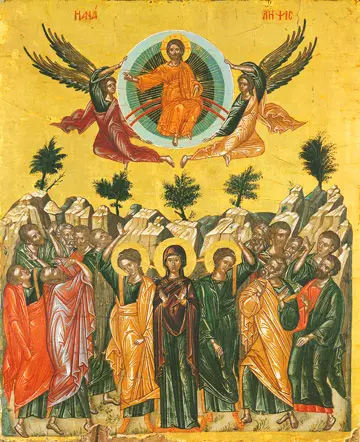
CHRIST’S THIRD UNIFICATION: HIS ASCENSION
Then, by His ascension into heaven, it is obvious that He united heaven and earth, for He entered heaven with His earthly body, which is of the same nature and consubstantial with ours, and showed that, according to its more universal principle, all sensible nature is one, and thus He obscured in Himself the property of division that had cut it in two.
CHRIST’S FOURTH UNIFICATION: CONVERGES TWO REALMS
Then, in addition to this, having passed with His soul and body, that is, with the whole of our nature, through all the divine and intelligible orders of heaven, He united sensible things with intelligible things, displaying in Himself the fact that the convergence of the entire creation toward unity was absolutely indivisible and beyond all fracture, in accordance with its most primal and most universal principle.
CHRIST’S FIFTH UNIFICATION: COMPLETING THE FATHER’S PLAN
And finally, after all of these things, He—considered according to the idea of His humanity—comes to God Himself, appearing as a man, as it is written, before the face of God the Father on our behalf—He who as Word can never in any way be separated from the Father—fulfilling as man, in deed and truth, and with perfect obedience, all that He Himself as God had preordained should take place, having completed the whole plan of God the Father for us, who through our misuse had rendered ineffective the power that was given to us from the beginning by nature for this purpose.
SUMMARY
Thus He united, first of all, ourselves in Himself through removal of the difference between male and female, and instead of men and women, in whom this mode of division is especially evident, He showed us as properly and truly to be simply human beings, thoroughly formed according to Him, bearing His image intact and completely unadulterated, touched in no way by any marks of corruption. And with us and for us He encompassed the extremes of the whole creation through the means, as His own parts, and He joined them around Himself, each with the other, tightly and indissolubly: paradise and the inhabited world, heaven and earth, the sensible and the intelligible, since like us He possesses a body, sense perception, soul, and intellect, to which (as His own parts) He associated individually the extreme that was thoroughly akin to each one of them (i.e., His parts), according to the mode described above, and He recapitulated in Himself, in a manner appropriate to God, all things, showing that the whole creation is one, as if it were another human being, completed by the mutual coming together of all its members, inclining toward itself in the wholeness of its existence, according to one, unique, simple, undefined, and unchangeable idea: that it comes from nothing.
The Technical Explanations
CREATION, EX NIHILO [FROM NOTHING], LEADS TO THE CREATOR
Accordingly, all creation admits of one and the same, absolutely undifferentiated principle: that its existence is preceded by nonexistence. For according to the true doctrine, all beings after God, which possess their being from God by virtue of having been created by Him, coincide with all the others (even if not in absolutely all respects)—and in general no being, including those from among the greatly honored and transcendent, is completely free by nature from the condition of general relation to what is Itself totally unconditioned, nor is the most ignoble among beings completely destitute or devoid of a natural share in the general relationship to the most honored beings.
EXPLAINED IN THE LANGUAGE OF ARISTOTELIAN-PORPHYRIAN PHILOSOPHY FROM LATE ANTIQUITY

For all things that are distinguished from each other by virtue of their individual differences are generically united by universal and common identities, and they are drawn together to one and the same by means of a certain generic principle of nature, like genera that are united with each other according to substance, and consequently have something one and the same and indivisible. For nothing that is universal, or which contains something else, or which is a genus, can be divided in any way by what is particular, contained, and individual. For that which does not draw together things that are naturally separated is no longer able to be generic, but rather divided up together with them and so departs from its own individual unity. For every generic item, according to its own proper principle, exists as a whole indivisibly and really in the whole of those things subordinate to it, and with respect to the particular it is viewed as a whole in general. Species, according to their genus, being released from variations grounded in difference, likewise admit of identity with each other. Individuals who share common features with each other according to their species become completely one and the same with each other, since by virtue of their common origin and nature they are indistinguishable and free of all difference. Accidents, finally, also possess unity, on the level of the subject, where they are in no way scattered.[13]
EXPLAINED IN THE LANGUAGE OF ST. DIONYSIUS THE AREOPAGITE

And the unerring witness to these things is the true theologian, the great and holy Dionysius the Areopagite, who, in the chapter on the “Perfect and the One” in his treatise On the Divine Names, says the following: “For there is no multiplicity which does not in some way participate in the One, but that which is many by its parts, is one in the whole; and that which is many by its accidents, is one in the subject; and that which is many in number or potentialities, is one in species; and that which is many by the species, is one by the genus; and that which is many by the processions, is one in its source. And there is none among beings that does not participate in some way in the One.”[14] And simply, to speak concisely, the principles of whatever is separated and particular are, as they say, contained by the principles of what is universal and generic, and the more generic and more universal principles are held together by wisdom, whereas the principles of particulars, which are contained in various ways by those of the generic terms, are encompassed by prudence, according to which, having first been simplified and divested of the symbolic diversity they acquire in lower material things, are made one by wisdom, having received the natural affinity that leads to identity through the more generic principles. But the Wisdom and Prudence of God the Father is the Lord Jesus Christ, who through the power of wisdom sustains the universals of beings, and through the prudence of understanding embraces the parts from which they are completed, since He is by nature the Creator and Provider of all things, and through Himself draws into one those that are separated, dissolving strife among beings, and binding together all things in peaceful friendship and undivided concord, both in heaven and on earth, as the divine apostle says.
Conclusion: Another Contemplation of this same difficulty
Again, the “natures are innovated,” since the Divine [i.e., St. Gregory the Theologian], in its goodness and measureless love of mankind, accepted in a manner beyond nature, and according to its own free will, our fleshly birth, while our nature paradoxically and by a strange ordinance contrary to nature produced flesh, endowed with a rational soul, without seed, for the sake of God, who became flesh, and this flesh was in every way the same and indistinguishable from ours, but without sin—and what is more paradoxical, His birth did not diminish in any way the virginity of the one who became His mother.[15] Strictly speaking, the “innovation” is not only the fact that God the Word, who was already timelessly and ineffably begotten of God the Father, was born in time according to the flesh, but also that our nature gave flesh without seed, and that a virgin gave birth without corruption. For each of these clearly manifests the innovation, while at the same time on the one hand concealing and on the other hand revealing the ineffable and unknown principle according to which they took place; concealing in accordance with the mode that is beyond nature and knowledge, and revealing by the principle of faith, by which all things beyond nature and knowledge may readily be grasped.
In this way, then, as it seems to me, the difficulty is resolved as best it can be—I, in any case, do not know how one might otherwise explain it. It is now for your philosophical mind either to approve of what has been said, or to discover on your own and give expression to a better and wiser solution, and to communicate to me the fruit of heavenly knowledge free of all earthly elements.

SOURCE:
Maximos the Confessor, "Ambiguum 41," in On Difficulties in the Church Fathers: The Ambigua, Volume II, edited and translated by Fr. Maximos (Nicholas) Constas (Cambridge, MA: Harvard University Press, 2014), pp. 103–121.
ENDNOTES:
[1] Gregory the Theologian, Or. 39.13 (SC 358:176, ll. 8-9); see vol. I, Amb 5.7; and below, Amb 42.26-29. [St. Gregory’s homily 39.13 found in Gregory the Theologian, St., Nicene and Post-Nicene Fathers, Series II, Volume VII: Oration of the Holy Lights (#39). Translated and edited by Philip Schaff, Henry Wace, William Moore, and Henry Austin Wilson (Peabody, MA: Hendrickson, 1996), pp. 356-357.]
[2] See QThal 48 (CCSG 7:333-35, ll. 65-81).
[3] These first two divisions are discussed by Gregory of Nyssa, Against Eunomios 1 [270-72] (GNO 1:105-6, ll. 19-11); and ibid., 2 [66-67] (GNO 2:209-10, ll. 19-11).
[4] “Workshop” renders the Greek word ergasterion, which here suggests a center of both production and exchange, as described by Chrysostom, On the Statues 16 (PG 49:172A). The word also has the metaphorical sense of a “womb”; see Philo, Life of Moses 2.85 (LCL 6:490); Clement, Stromateis 3.12.83 (GCS 52:234); Gregory the Theologian, Or. 28.22 (SC 250:146); and Proklos of Constantinople, hom. 1.1, 14 (ed. Constas 2003, 136, see 149-50).
[5] Maximos has taken the Platonic principle of cosmological analogy and placed it at the center of his philosophical anthropology; see vol. I, Amb 17.8, n. 14.
[6] See LrdPr (CCSG 23:33-34); and Dionysios the Areopagite, CH 1.1 (7,ll. 4-5; 120B).
[7] See Philo, On the Creation of the World 25-29 (77-88) (LCL 1:60-72); Gregory the Theologian, Or. 38.11 (SC 358:124-26); id., Or. 44.4 (PG 36:612AB); Gregory of Nyssa, On the Making of Man 2 (PG 44:132D-133B); and Nemesios of Emesa, On the Nature of Man 1 (ed. Morani 1987, 4, ll. 12-16).
[8] See Gregory of Nyssa, On the Making of Man 17, 22 (PG 44:188D, 205A); id., Against Apollinarios (GNO 3/1:212, l. 6-7); id., On Ecclesiastes 6 (GNO 5:386, ll. 18-21).
[9] See Gregory of Nyssa, On the Making of Man 17, 18 (PG 44:188C, 189C, 196A); id., Against Apollinarios (GNO 3/1:212, l. 4); id., On the Song of Songs 1 (GNO 6:30, l. 7).
[10] Dionysios the Areopagite, DN 9.2, cited above, Amb 35.2, n. 3.
[11] Gregory the Theologian, Or. 39.13 (SC 358:176, ll. 8-9).
[12] See QThal I (CCSG 7:47, ll. 5-17); LrdPr (CCSG 23:47, ll. 341-43; pp. 49-377-51.14; p. 54, ll. 467-70); and Gregory of Nyssa, On the Making of Man 16-17, 22 (PG 44:177D-192A, 205A).
[13] See Gregory of Nyssa, On the Making of Man 24 (PG 44:212D-213C).
[14] Dionysios the Areopagite, DN 13.2 (227, ll. 13-17; 980A).
[15] See vol. 1, Amb 5.7.


Comments