

A Juridical Theory of Salvation Poisons the Spiritual Life
- The Orthodox Ethos Team

- Jan 27
- 11 min read
Excerpts from "Bethlehem and Golgotha" in the new book from Uncut Mountain Press--Bible, Church, History: A Theological Examination.
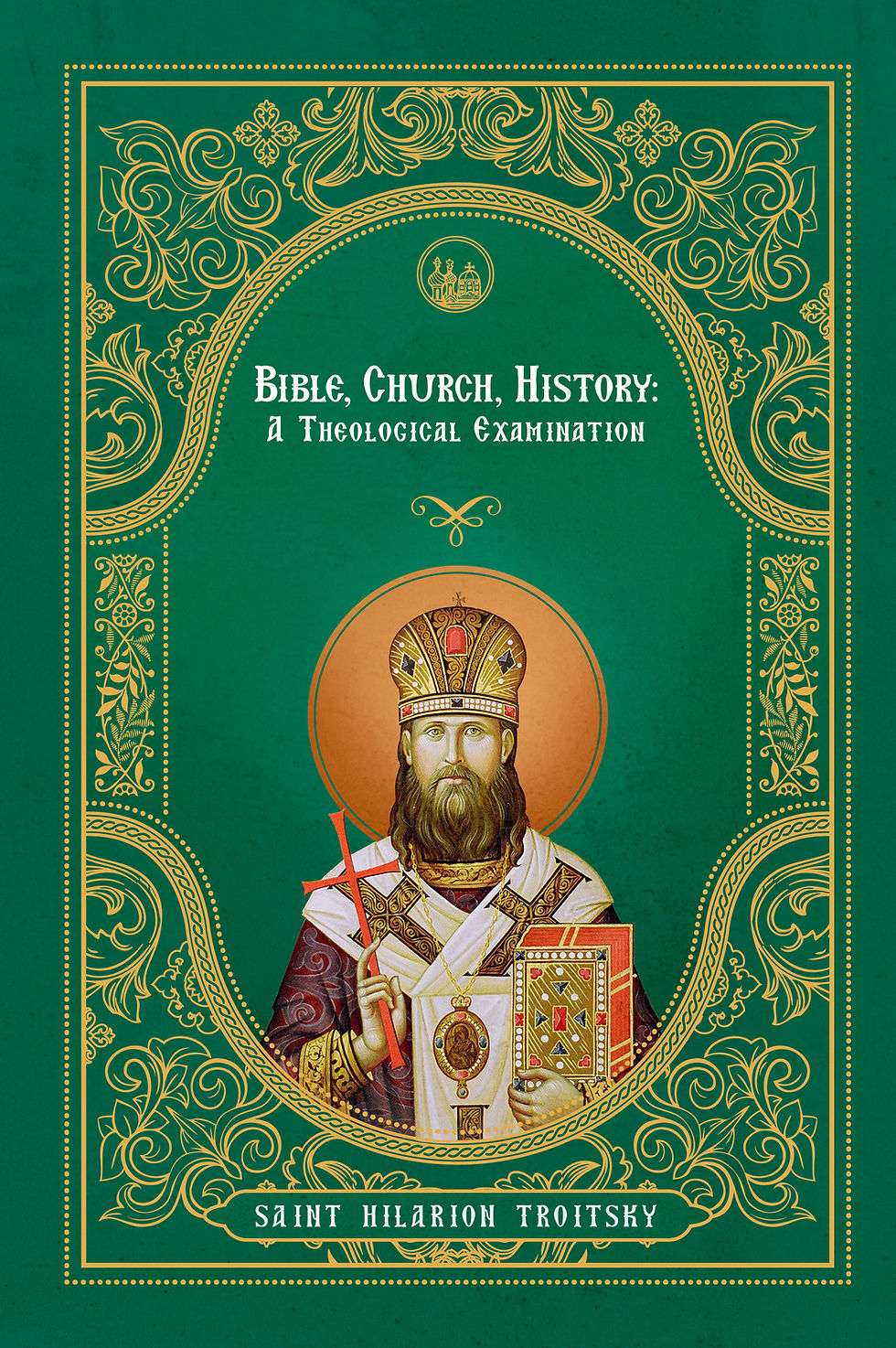
Editor's Note: Today we share a few excerpts from St. Hilarion (Troitsky) concerning atonement and redemption. He gives a very clear picture concerning this teaching, not only in Russia, but all over Europe, and not only in his day, but in the centuries leading up to his day. Like a skilled doctor, he examines the teaching from a few angles and gives a Spirit-filled diagnosis on how one's view on Christ's work at the Crucifixion and at his Nativity will determine whether one leads a healthy spiritual life or not, and whether one's ideas conform to the liturgical teachings of the Church. As many enter into the Church, some not releasing their baggage from Papal Protestant ideas concerning atonement, St. Hilarion presents the teaching of the Church from Her Services, and many saints on the matter. Much more supporting evidence and arguments are given fully in the chapter, but here we take some paragraphs to illustrate the poisonous nature of a juridical theory of salvation.
Excerpts from "Bethlehem and Golgotha"
My dear friend,
Ten years ago here in Russia, in Erivan, a composition by the holy hierarch Irenaeus of Lyons, Demonstration of the Apostolic Preaching, of which the Greek original had been lost, was discovered in an Armenian translation. We became acquainted with this composition in the German translation, which in turn has been translated into Russian. In this composition some seven years ago I was particularly struck by the following words: “Others ascribe no significance to the descent of the Son of God and the economy of His Incarnation, through which the apostles proclaimed and the prophets foretold that our humanity is to be brought to perfection. And such should be numbered with those who lack faith” (ch. 99). Do you know, friend, what these words of the holy father seem to me to be? They seem to me to be a reproach against our modern times. The holy father is reproaching our modern times for a lack of faith. It is no accident that these words resounded at the dawn of the twentieth century! People are becoming increasingly forgetful of the economy of the incarnation: they do not believe in it, they wish to do without it, and in their beliefs they replace the incarnate Son of God with a great man and a great teacher, Jesus of Nazareth...

...My gaze is turned toward our scholastic theology, and—alas!—I see clearly that it does not teach people to meet the feast of Christ’s Nativity in the fullness of theological contemplation. To a considerable degree, St. Irenaeus of Lyons’ reproach for a lack of faith also applies to our scholastic theology: the latter does not ascribe sufficient importance to the economy of the incarnation, and does not at all teach that it is through this economy that our humanity must be brought to perfection. In our scholastic theology the focal point of our salvation has been shifted from Bethlehem to Golgotha. This shift in our Russian theology occurred comparatively recently, about two hundred years ago, when the Latin theological trend came to Moscow via Catholic Poland and Kiev, and when various scholastically-minded fathers acquired greater authority than the ancient fathers of the Church. The reasoning of the ancient Church concerning salvation is incomparably more lofty and engaging than our modern Latin-leaning theology...
... when you take up the seminary dogmatic textbook (of Macarius), you cannot help but be amazed at how meager the thinking becomes the moment it touches on the incarnation. The book contains not even a whole paragraph devoted to the incarnation. Of interest is §86: “The consequences of the hypostatic union of two natures in Jesus Christ.” Three different kinds of consequences are distinguished: (a) with regard to Himself; (b) with regard to the Most Pure Virgin, His Mother; and (c) with regard to the Most Holy Trinity. For the human race, then, the hypostatic union of two natures in Jesus Christ was supposedly of no consequence at all! But this means that the inseparable link between the incarnation of the Son of God and our salvation is dissolved. While not obliterated perhaps, the primary idea by which the Church of Christ lived and was inspired for entire centuries, for which they fought and labored, is darkened and distorted...
... Our scholastic theology, however, has cast a pall over the truth of the incarnation, with the result that its doctrine of salvation cannot satisfy the believing, salvation-craving human soul. For outsiders, the doctrine of salvation as it has been set forth in programs of study for two hundred years is merely an object of ridicule and sacrilege. Leo Tolstoy mocked this doctrine in his Critique of Dogmatic Theology—mocked it grossly—yet several of our theologians have been obliged to object that Tolstoy was wrong to take Macarius’ dogmatic theology to be the teaching of the Church.

I recently came across an academic textbook—a grammar school Law of God handbook. When I read the discussion of the fourth article of the Symbol of Faith—I tell you frankly, my friend—I was chilled and even horrified. There the juridical theory of salvation that our dogmatists developed in the nineteenth century is presented in particularly crude form. Bear in mind that the lessons assimilated in childhood can affect one’s religious concepts and, ultimately, the ordering of one’s spiritual life. Secular higher education will provide nothing. And the juridical model of salvation can be highly hazardous to spiritual life...
... My friend, one cannot celebrate the Nativity of Christ with such thoughts as these. After all, what is the Nativity of Christ? It is the birth of a Person Who can be punished so severely that the righteousness of God is satisfied. The juridical theory casts a pall over the great feast of the Nativity of Christ. Furthermore, this theory bedims even the light-bearing night of the Resurrection. I have always marveled at the impoverished state of the paragraph on Christ’s resurrection in our dogmatic textbooks. In reading these paragraphs I am left with this impression: the author senses that it would be inappropriate not to write of the resurrection, but he is at a loss for what to write. And so it is that some see Christ’s resurrection merely as proof that the satisfaction offered through the sufferings of Christ has been accepted—that it is valid. Macarius has less than a page on the resurrection of Christ. To be sure, Christ’s resurrection is viewed there as a victory over death, but the reasoning as to why the rest of us will also rise one day as a result of Christ’s resurrection is vague and unconvincing. Thus, my friend, in focusing on Golgotha the juridical theory deprives us of the full joy of the feasts of Christ’s Nativity and Resurrection.

And what conclusion for moral and spiritual life do you suppose may be drawn from the juridical theory? I think the direct logical conclusion from this theory is the denial of all spiritual moral life. After all, Christ suffered for us and paid our debts. Has this made us better or purer? The guilt of sin has been lifted from us. Suppose the punishment prescribed by law has been erased from a thief’s docket. Has he ceased to be a thief? Is there even any need for us to be better? Who requires this of us, and why? Is there any need for us to avoid sin or to struggle against it? After all, a “superabundant,” infinite satisfaction has been offered for us, and this is sufficient for any number of my sins. And so Catholics and Protestants, who blindly believe the juridical fiction of medieval scholasticism, have taken this theory to its logical conclusion: they have blotted out all of moral life. In theory, that is—not in practice, for the heart sometimes senses the truth better than logic. You may be wondering, my friend: how can it be that Catholics and Protestants have blotted out moral life? Yet this is precisely the case. If our relationship with God and our salvation are limited to juridical reckonings, offense, punishment, and satisfaction, and if even a “superabundant” satisfaction has been offered for us, we may live however we please. Go ahead, rack up your debts—Christ has already paid them in advance. And so in place of the labor of struggling against sin we see a sacrilegious trafficking in indulgences to this very day.
Do not think that indulgences are an abuse. They are directly inferred from the juridical theory of atonement. The Catholic theologians are simply more consistent than our own. In presenting the juridical theory of atonement, for a long time our dogmatists keep step with their Catholic models; but then, sensing something amiss, they diverge and become entangled in contradictions. The Catholics, however, continue boldly on to the point of absurdity. Our people wish to correct the Catholic doctrine, when it must actually be discarded in its entirety. Even our own most reverend Sylvester speaks respectfully of Anselm, finding nothing contrary to Orthodoxy in his writings. And how do people think to correct Catholic dogma among us? They develop the doctrine of the subjective aspect of atonement. Man, they say, must also participate in satisfaction on his own—by faith, good works, sufferings in life, crucifying the flesh with its passions and lusts. Now, this is something I cannot comprehend in the least! If Christ has made satisfaction for me, and “superabundant” satisfaction at that, what can I myself possibly add to this? Eternity will become no greater, however much you add to it. Furthermore, formerly I was told that I could not satisfy God’s righteousness, and that the Son of God had done so; but now I find that supposedly my own satisfaction is also of some significance—as though without it even the infinite satisfaction made in the death of the God-man upon the cross is insufficient! What, then, are my good works, my struggle with sin and the passions—a condition of salvation or a consequence of salvation? Am I good because I am saved, or am I saved because I am good? Thus, in straying from the Catholic path, our dogmatic theology finds itself in an impenetrable forest of irreconcilable contradictions.

Again, in what light does my whole moral life appear when it is artificially bound to a juridical theory of salvation that can manage quite well without it? The juridical theory, as I said, turns all of Christ’s earthly life into a punishment. In the same way, my spiritual life is presented as a punishment. I wish to be virtuous not because it is good and joyful in and of itself, but because I must satisfy God’s righteousness by my painful and unpleasant struggle. This view of things alone is enough to destroy true spiritual life. I pray not because my soul desires this; no, rather, I am “praying my sins away.” The words of the poet come to mind:
For you, prayer means to whine for a place
On the cart drawn into paradise by Christ.
Almsgiving, fasting, worship—all these are external works, which are credited to my account to be repaid with a reward, or at the very least with mitigation of my future punishment. Indeed, a person who lives in the context of civil relationships, which are external and by necessity juridical, is always inclined to project juridical views upon the matter of salvation, as well. But this, my friend, should be viewed as an abasement of the idea of salvation in condescension to human weakness. Tawdry pictures of the Last Judgment may depict the weighing of men’s deeds upon scales, but to elevate this concept to the status of a dogmatic theory—no, to this I will never acquiesce, and I will always fight against it.

Thus, my dear friend, we cannot accept the juridical theory of salvation, which disdains both the incarnation and the resurrection, and knows only Golgotha with its darkened sun, troubled creation, the quaking earth, the rocks rent. This theory is not ours; it is not of the Church. It insinuated itself into ecclesiastical theology a mere two hundred years hence, gaining traction here after the devastation that Peter I inflicted upon the Orthodox Russian Church. This theory, when adapted to Orthodoxy, is contradictory and explains nothing. Finally, it is expressly detrimental to moral life. But just imagine, my friend: even among us to this day this theory finds champions who defend it with an energy that deserves to be put to more honorable use. I cannot possibly comprehend what good it is to them, why they value it, why they find it so endearing and agreeable. Yet some are actually inclined to view a rejection of the juridical theory of atonement as some sort of campaign against Orthodoxy. Even concepts so indisputably foreign to Orthodoxy as satisfaction and merit find their champions among us. But to my mind, to admit these concepts into theology is to distort the pure image of sound doctrines concerning salvation. Worthy of particular note, my friend, is this. In our country the opponents of the juridical theory of atonement (among whom I consider it my sacred duty to number myself) are sometimes accused—of what, do you suppose?—of Protestantism. But—dear God!—the Protestants are no better than the Catholics in their false thinking regarding salvation. They too adhere to the juridical theory. The opponents of the juridical theory point to its indisputably Catholic origins, and its champions then reproach them for having German Protestant sympathies. I tell you frankly, my friend: I have not read a single Protestant German tract on salvation. I attempted it, but after a few pages I cast it aside in disgust: it was the same lifeless scholasticism as that of the Catholics or of our own dogmatists of the eighteenth and nineteenth centuries. I myself have derived the doctrine of salvation from the holy hierarchs Irenaeus of Lyons, Athanasius the Great, Gregory the Theologian, Gregory of Nyssa, and Cyril of Alexandria, from the venerable John of Damascus, and from all our liturgical books, where the inspired hymnographers of the ancient Church speak their words. Thanks be to the Lord God, here in Russia over the past twenty-five years blind faith in the inventions of medieval Catholicism has begun to waver considerably...

Thus presented, my dear friend, the doctrine of salvation appears to me to be pure and lofty, consistent and coherent, free of the mercenary, mercantile spirit of Catholic dogmatic theology and Protestant sophism. It is this doctrine that prompts me toward the saving labor of struggle with sin, toward cleansing the heart of sinful habits, toward establishing my will in good. The juridical reckoning of merits and good deeds must be foreign to the moral domain: it is the domain of purely nominal human relations, and nominal morality is not morality at all. It seems to me that in the domains of both theological and moral doctrine one can manage quite well without the juridical component. This element separates morality and theology; but in the Church’s understanding of salvation, theology leads directly to morality. As a consequence of the salvation that Christ accomplished, man works out his salvation in ascetic struggle with sin and the passions, and this working out of salvation itself affords bliss to the worker. The cross of Christ is not abolished, nor is Golgotha bypassed in the proffered understanding of salvation, but rather it is given the place that indisputably belongs to it in the system of the divine economy. The difference is that no pall is cast over the silent night of Bethlehem and the bright night of the Resurrection. The mind that theologizes concerning salvation comes to Bethlehem, sees the Infant lying in the manger, and reverently bows the knee before Him as the Savior of the world. In secret Christ was born of the Virgin in a cave, in secret He rose from the cave of Joseph of Arimathea, but the theologizing mind sees in the Nativity the making of a new creation and man’s deification, while in Pascha it celebrates the victory over corruption and death. The juridical theory of atonement shrouds these two celebrations in gloom, stripping them of their full meaning and revolving around Golgotha alone...
Read the full chapter in Bible, Church, History, available from Uncut Mountain Press!


"Be kinder than necessary because everyone is fighting their war or battle and suffering losses. Live simply, love generously, care deeply for the needs of your neighbour, speak softly... And leave the rest to the Lord. It is not faith, nor dogmatics, nor mysticism, nor ascetism, nor fasting, nor long prayers, but love that makes one a true Christian.“ St Luke the Surgeon