

Fasting is Divine Grace
- The Orthodox Ethos Team

- Mar 3
- 5 min read
From Conversations With Elder Dionysius Ignat
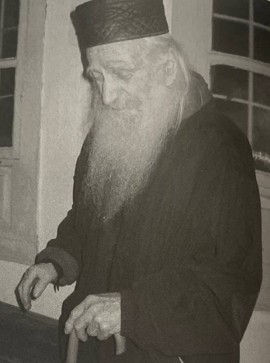
From the Editor: Elder Dionysius (1909-2004) is a Romanian monk who was recently canonized as Saint Dionysius of Colciu. He was "from Botoșani, became a monk on Mount Athos at age 17, living 78 years as a hermit and spiritual father at the Cell of Saint George – Colciu. He was canonised by the Ecumenical Patriarchate in 2025 and is commemorated for his humility and wisdom on May 11" (from here). Below we offer inspiring and insightful counsel from him on fasting.

Q: Fr. Dionysius, tell us about fasting. Christians do not follow the fasts as well today as they used to. Everyone fasts as he wants...
A: Indeed, everyone fasts as he wants. But not everything happens as we would like.
The fasts were established by the Holy Fathers at the Seven Ecumenical Councils, and, if we observe them, we are given great Divine grace. If you do not follow them, then we start saying things like: “Ah, the Apostles’ Fast! Yeah, it is not so important. The Dormition Fast! I mean, the Theotokos knows that we cannot fast Great Lent! It is just too long—seven whole weeks!” And so, you fabricate all kinds of excuses for yourself, and you completely walk away from the fasts. But if there is not fasting, there is nothing! After all, fasting is Divine grace.
And look, fasting has already been diluted long ago. When I was a boy, in school, people fasted in Great Lent only in the first week and in Holy Week, and in the interval in between them, they allowed themselves to eat everything. But if this is far from the truth[1], and if you have departed from the truth, it means we have already begun to limp. First, you are hobbling on one leg, then on both, until you are saying: “Oh, God knows! I am going to live like everyone else.”
Do you see? You have to have a little attention; a little attention and God will help us.
Q: Indeed, what kind of Christian is it that does not respect fasting? Then it does not matter of what faith you are. You say you are a Christian, but if you do not fast, then how do you differ from a pagan?
A: Do you see how evil progresses? The Catholics have not fasted, and they justify themselves with proofs from Scripture, as they understand it, as if fasting weren't necessary at all. But the Catholics were at the Seven Holy Ecumenical Councils, since there was no division between us then—however, little by little they reached the point where they no longer fasted.
I was talking with a Catholic nun in Romania in 1939, and she told me: “If I am able, then I do not eat meat on Holy Friday—if I am able; and if not, then I eat meat.”
On Holy Friday, when the Savior was lifted up on the Cross, Catholics say there is nothing wrong with eating meat! They also were Orthodox Christians like us [at one time] and look what happened.
I am telling you this as an example. After all, look, when someone starts to come down from a mountain, he practically runs; for when you walk down, it is more difficult to stop. It gets to the point where someone says: “Why should I fast? Scripture says: ‘what comes out of the mouth... defiles a man’ but ‘what goes into the mouth’ does not defile him” (cf. Mt. 15:11).
Yes, it is so, and it is not so. All of the fasts were established by the Holy Fathers so that, in fasting, you might diminish your passions. You observe the fast by honoring the Savior's passion: “I fast because the Savior suffered for me,” and so on. But, in the state that humanity is in now, what else can we expect?
—from a conversation with a monk of Lacu Skete on Mt. Athos,
November 9, 2002
Q: People say you cannot fast now because if you fast and do not eat meat, you will not be able to do physical work.
A: You see, people think this way, but it is a delusion. It is a deception of the enemy, because human nature is full of passions now. And if the passions settle into the mind, heart, and thoughts of a man, they become second nature. If they become second nature, then he begins to say: “If I do not eat meat, I will die. That is all there is to it.” And with such thoughts, he truly will die!
But it is not true. This is a passion imposed by the tempter, who manages the storehouse of all evils and throws the seed of evil deeds at us, into our hearts and souls. And if our nature inclines towards one of these evils that he throws at us, then he will henceforth “help” us with this evil. You want to drink vodka—he will “help” you with it! You want to eat a little more sumptuous food—he will also “help” you with this, until the evil has settled into your soul. You want to tell a lie—he will “help” you with it, until the passion takes root, until it sprouts; and if it sprouts, then it already takes root in your heart and soul. And if it has taken root, then this root becomes a second nature, and you are already convinced that if you do not eat or drink what you want, you will die. But it is not true! This is the work of the tempter.
That is, the passion that entrenched itself and took root in the human heart is harder to uproot. Therefore, the Holy Fathers teach that every evil thought that exists in our hearts and souls is evident, and we must be certain that it is from the tempter and make haste to our spiritual father and tell him: “This is what my mind tells me, Father. My mind inclines to this and that”—so your spiritual father may instruct you as the grace of the Holy Spirit enlightens him.
And by doing so, you disgrace the enemy; because if you do not go to confession, then the passions he introduced into your heart and soul will destroy you. And when you simply cannot find a priest, confess to one another, as the Holy Apostles say (cf. Jas. 5:16), to at least get some help and healing-for you cannot be healed any other way.
—from a conversation on April 27, 2002
Rivers of Living Water, pp. 165-169
ENDNOTES
[1] “If any bishop, or priest, or deacon, or subdeacon, or reader, or singer fails to fast throughout the forty days of Holy Lent, or on Wednesday, or on Friday, let him be deposed from office, unless he has been prevented from doing so by reason of bodily illness. If, on the other hand, a layman fails to do so, let him be excommunicated” (Canon 69 of the Holy Apostles. Cf. Canons 29, 56, and 89 of the Sixth Ecumenical Council, Canons 49, 50, and 52 of the Council of Laodicea, Canon 15 of St. Peter of Alexandria, Canon 1 of St. Dionysius of Alexandria, and Canons 8 and 10 of St. Timothy of Alexandria).


Beautiful words from a holy man! May we heed them. Thanks for sharing!
Correction for comment below "Cannons" say this.. my apology for error
"Endnotes" ... Deposed or Excommunicated.. Canana say this !!! Wow .. this is Serious .. glad to learn this.
More than a decade ago, Prince Charles was known to be confessing to St. Dionysius...